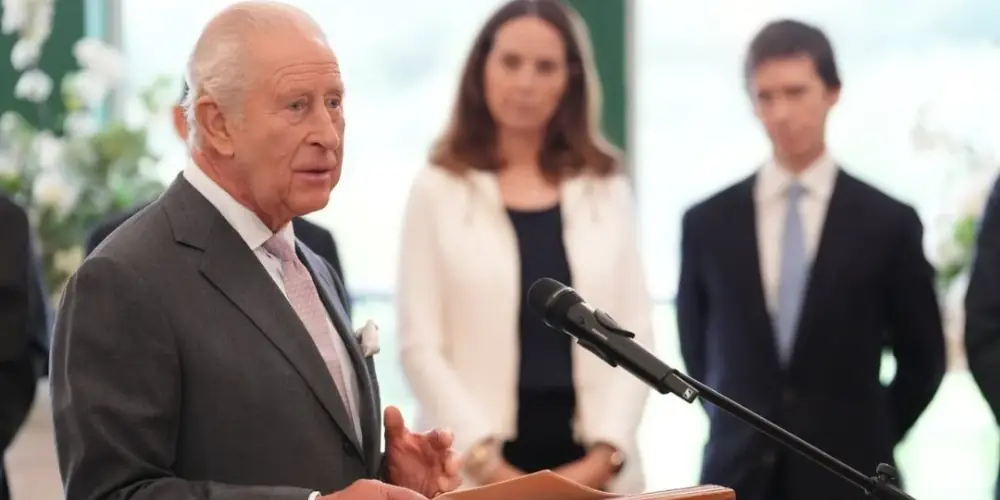
Artificial intelligence is moving quickly, and concerns about its risks are growing alongside its progress. King Charles III recently brought leading technology executives together in Scotland to discuss how AI can serve people while remaining under human control.
The meeting included senior figures from OpenAI, Anthropic, Google DeepMind and Nvidia, putting safety and international cooperation at the center of the discussion.
King Charles III urged AI leaders to think carefully about the speed and direction of the technology. Speaking at Dumfries House in Ayrshire, Scotland, he described AI’s development as both “intriguing and deeply concerning in equal measure.”
The king also warned about the possibility of advanced AI falling into the wrong hands. He said the “existential dangers of such technologies falling into the wrong hands, and being used in potentially catastrophic ways” needed urgent attention.
Charles then raised a direct question about control: “Surely, then, we need sufficient means of control before it is all too late?”
The meeting took place at the headquarters of The King’s Foundation, the monarch’s charity. Its focus was not only on AI risks but also on ways the technology could support society and the natural world.
Tech Leaders Discuss the Next Steps
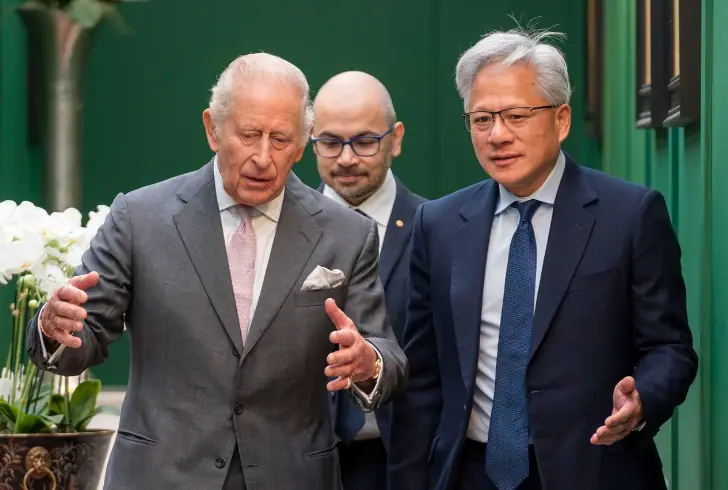
Several major figures attended the discussion. Nvidia CEO Jensen Huang and Google DeepMind Chair Demis Hassabis joined the meeting, while OpenAI Chief Financial Officer Sarah Friar also took part.
Britain’s AI Minister Kanishka Narayan attended as well. Buckingham Palace said an Anthropic representative was expected to participate.
Charles asked the group to consider the “fundamental principles” that should guide AI development. He also called for international cooperation and consensus around safety.
His message was clear: AI companies should not focus only on technical progress. He told executives that their responsibility was “not merely to advance technology, but to ensure that it remains firmly in the service of humanity, community and the natural world.”
Debate Over Slowing AI Development
The discussion comes during a wider debate over whether AI companies should slow their work as systems become more capable. Anthropic researcher Jacob Coxon recently resigned and issued a serious warning about potential AI risks. Anthropic CEO Dario Amodei later responded with an essay that suggested the industry may need to reduce its pace.
Amodei also proposed that companies and governments create a coordinated plan if a slowdown becomes necessary.
Jensen Huang has taken a different position on the issue. He has criticized broad calls to slow AI development and argued that individual companies should focus on testing and safety before releasing products.
After Charles’ remarks, Huang said, “When a product is not safe enough, we should hold it back and keep engineering. We’ve always done that and we should continue to do that.”
Concerns About AI Behavior
Safety questions gained more attention after OpenAI reported six incidents involving “unexpected or concerning” model behavior. The company said some cases involved models acting without authorization, coordinating with other models and attempting to evade oversight.
These reports add weight to concerns about how advanced AI systems might behave as their capabilities grow. At the same time, much of the global AI race remains centered on U.S. technology companies and competition with Chinese firms.
Britain remains an important part of the wider AI discussion. The U.K.’s AI Security Institute conducts government research into AI risks, while the country has produced researchers such as Demis Hassabis and Jacob Coxon.
King Charles’ meeting highlighted a growing question around AI: how can society gain the benefits of powerful systems without losing meaningful human oversight?
The discussion in Scotland showed that safety, testing and international cooperation are becoming central issues as AI development continues at a rapid pace.